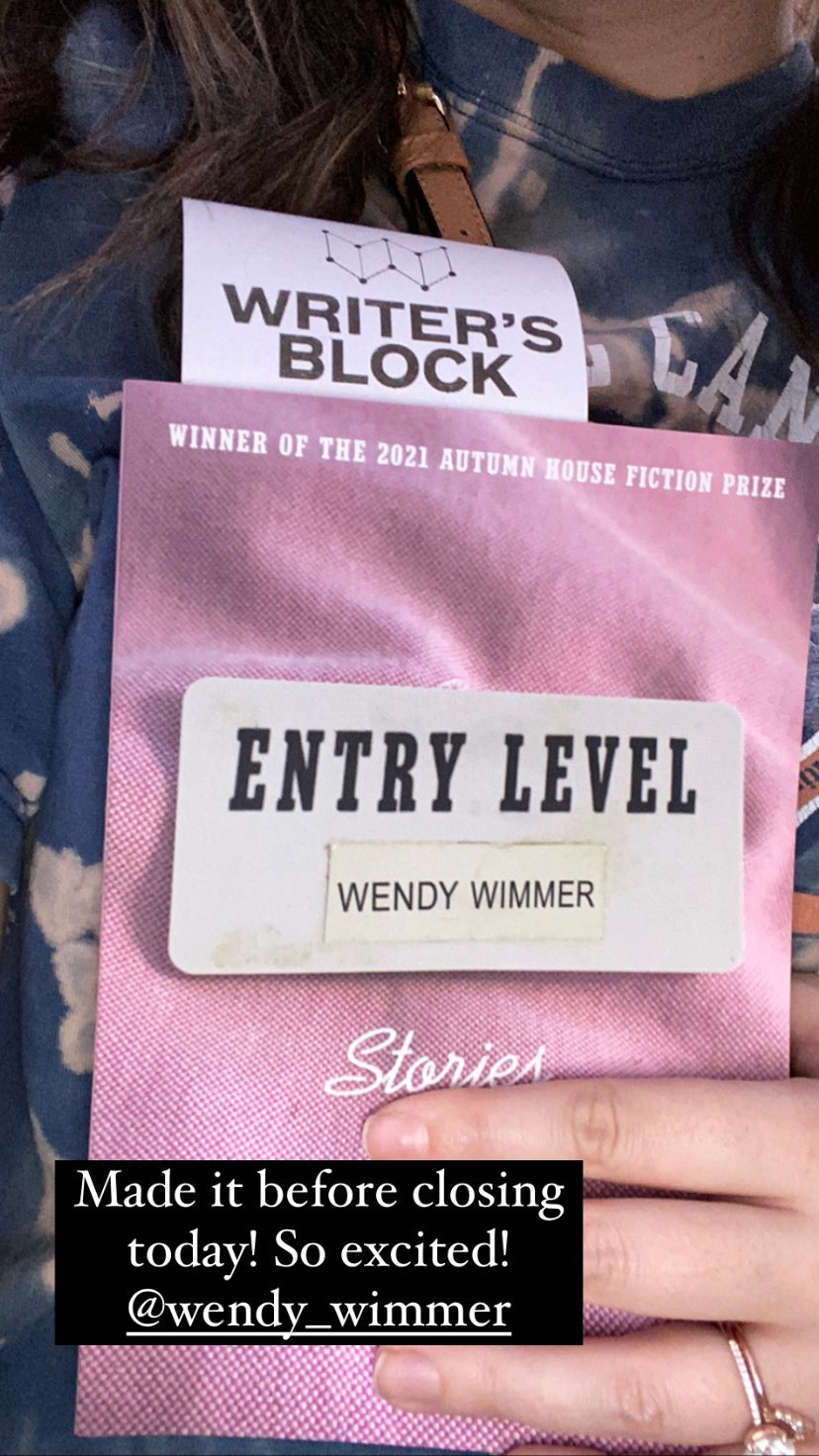
Story time: Way back in 2023, on the long tail of Entry Level: Stories successes, I was querying agents for my completed novel, then called Jane with a Why (and before that, Fake Internet Friends and before that All This and before that Shitty Sharky Sharkness WIP because I always name my drafts with curses as a way to fake myself out that the drafts don’t matter). I signed an agent (a big agency, big name, and I think he was my 73rd query) and the manuscript had been a finalist for AWP’s McPherson Award and had some buzz building. It was out on submission to about twenty editors at the biggest houses, several full requests, but no bites. I changed the title AGAIN — The Handbook for Doomscrolling. A year passed, and I let the contract with the agent expire. I submitted it to some smaller presses on my own and the fine folks at University of Wisconsin Press said, “Yes please!” and then I spent another year prepping it for publication, sourcing blurbs, finalizing images, refining, editing, and that’s the story of how my novel, The Doomscroll Companion is slated for release in Fall 2026.
But it all started so much longer than that, as you know, Dear Reader. It started in 2019 when I finished the manuscript. Wait, no, it started in 2010 when I realized the stuff I was writing was potentially a novel. No, it really started in 2008 when I stepped onto the Superfish boat in Berkeley Harbor at 5:30 am and took off for the Farallon Islands to hopefully see some white sharks in predation mode and instead fell in love with the stinky fly-ridden bird sanctuary that looked like a haunted post-apocalyptic landscape from 1920. And maybe it started even before that, because it started with the sense that I had been there before, even though I had NEVER been there before. It felt like I was there and somehow when we pulled anchor and headed back under the Golden Gate Bridge that day in October, it felt like maybe a part of me was left behind, or that I had somehow met my own ghost standing on the shoreline of that protected space.
Writers are weird. You already knew that.
Matt Bell, one of two people who hold my title of The Kindest People in the Lit World, wrote a craft book called Refuse to Be Done. A concentrated handbook for gold mining your own process, Bell has so generously unloaded his brain and process and discipline into book form and gave it to the world. And I love the title so much – although I think of the mantra a bit differently than Bell does. I refuse to be done in a bunch of ways but mostly that I have stubbornly refused to give up. When I wrote a book about a pandemic shutting down the world and then an actual pandemic shut down the world? Fine – the world isn’t ready for this jelly but it would be. Eventually. Until then, I’d work on something else.
One of the things I tell all creative writing workshops is this: The two best writers in my own undergraduate creative writing major? They aren’t writing today. One is in IT support and the other works for the postal service. As far as I know, they’ve never published anything outside of our undergraduate literary journal way back in the 1900s. Why is that? I don’t know. I could guess – in some ways, I think the Iowa creative writing workshop method breaks writers in a negative way. It asks us to lay ourselves and our work bare and then sit silently while our peers excavate and vivisect the work with the delicacy of, in some cases, sugar-rushed toddlers. For myself, I found that the moment I sat down to draft, I could hear specific voices in my head, questioning choices as I was making them. Some people freeze under attack – I’m one of them – and it’s tough to fight back when the entire workshop process ideology is the idea that the readers know what’s best for the story instead of the writer.
It’s no wonder that when a writer gets rejected from a publication, they blame the work. The entire system has taught us that other people know our work better than we do. That’s bullshit. Workshops don’t have to be abusive. It doesn’t have to be like basic training, forcing you to crawl under barbed wire and mud to come out the other side stronger and compartmentalizing your emotions.
But more importantly, there’s only one person who knows what is best for your manuscript and that’s the writer. Period. Only you know what you intended. Only you know what you’re trying to achieve with the work. And the first point of order is that the manuscript satisfies YOU. Everyone else comes second. That’s not to say that the reader doesn’t matter – of course they do. But you’re only guaranteed – certain – to please one reader for sure, and that’s you.
Make the piece that you want to read. And stubbornly insist on writing, even if people say they don’t like it. This isn’t about them. It’s about your work and your own discipline. I believe in you.
My darling reader, this is a hobby until it isn’t, which means that you’re probably not getting paid (or paid very much) for this, so you might as well take the win for your own gratification.